


, Solving Problem Through Strategic Play


Team
Vaibhavi More | Milap Salot | Manav Oza | Facundo Sasson
Role
Team Lead | Game Design Strategist | Researcher
How it started?
How do you *teach* an "innovator's mindset"? This was the core challenge of our graduate course.
Project Overview
Innoverse is a board-and-card strategy game designed to bridge the "abstraction gap" in responsible management education. While students often grasp theoretical frameworks like the UN Sustainable Development Goals (SDGs) and PRME principles, they frequently struggle to apply them practically.
This project transforms passive learning into a multi-sensory, high-stakes experience where players step into the shoes of innovators to solve global crises through resource management and lateral thinking.
The Challenge
Traditional education on PRME’s and sustainability (SDG's)often relies on passive lectures. Our team was tasked with creating an experiential learning tool that:


Internalizes complex frameworks like the 7 PRME Principles and SDG's through active problem-solving.

Engages diverse learners (undergraduate to graduate levels) in a hands-on way-Reading about innovation doesn't make you an innovator.

Balances the tension between competition and collaboration to drive engagement.
The Design Process
As a multidisciplinary team-including architects and a industrial designer-we approached the project through a "Design Management" lens.

Market Research: We analyzed classic mechanics from games like Monopoly, Catan, and Uno to understand resource scarcity and player motivation .


CAD Visualization: Leveraging my background in architecture, we moved from low-fidelity cardboard mockups to finalized CAD-visualized board designs with precise dimensions.
Iterative Playtesting: The game underwent rigorous playtesting in classroom settings to refine the "pitch" mechanics and ensure the difficulty was appropriate for our target audience.


Game Mechanics: How it Works
Innoverse acts as a "conditioning program" for responsible leadership.

The Board: A circular map featuring 17 SDG Challenge Tiles, Resource Tiles, and Risk/Opportunity Tiles.

UN'S SDG and PRME


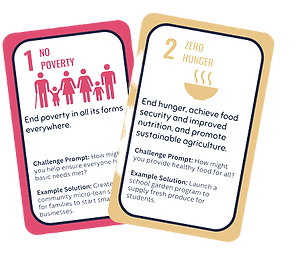
Resources: Players manage four types of tokens: Wood, Brick, Ideas, and Community.


Winning Condition: Be the first player to collect all 7 unique PRME cards to become the "Innoverse Changemaker".
The Pitch: Landing on an SDG tile requires the player to pay resources and "pitch" a solution using an immersive method such as acting, drawing, or building.


Peer Governance: Solutions are judged by other players based on how well they represent a specific PRME principle.
Strategic Value Proposition
The Experience:
A "Hackathon meets Improv" style that sparks laughter and debate while tackling complex issues.
Multimodal Immersion:
We developed a Spotify playlist with world-building narration, background music, and turn-timers to enhance the atmosphere.
Professional Development:
Players practice ethical decision-making and interdisciplinary collaboration required for real-world crises.
Game Manual
We translated our system strategy into core game mechanics. We turned each abstract principle into a concrete, playable rule or "product feature." We mapped the 17 SDGs as "Game Challenges" and the 7 PRME principles as "Action Cards." This created a clear loop: Use a Principle (Action) to solve an SDG (Challenge). We wanted this to be an immersive experience that is engaging for our target audience - university students.


Prototype, Playtest & Iterate
We rapidly built a low-fidelity prototype and conducted multiple playtesting sessions to validate the core game loop and player experience (PX). Based on the feedback from the tests, we refined the gameplay to simplify secondary features and modified winning strategy. Feedback also showed that while the mechanics worked, the energy was low. This pivot led to the integration of the multi-sensory audio layer.
Mechanics alone aren't enough. We needed to design the *atmosphere* to lower social barriers and encourage play.

Reflection
Innoverse is recognized for its potential in Quality Education (SDG 4) and submitted for international design awards. Feedback from our final launch indicated that while highly effective, future iterations could include:
Increased Complexity: Adding more intricate risks and opportunities for mature players.
Replayability: Expanding the challenge library for each SDG to allow for diverse solutions to the same problem.


